jerusalem, Old city

The Old City of Jerusalem is the spiritual heart of Christianity, where paths of faith, history, and architecture intertwine. It draws Orthodox, Catholic, and Protestant pilgrims from around the world, offering each tradition sites especially significant for prayer and reflection.
Orthodox Holy Sites
-
Church of the Resurrection (Holy Sepulchre) – the central site of Orthodox pilgrimage, marking the crucifixion, burial, and resurrection of Christ. It is also where the sacred Holy Fire ceremony takes place.
-
Chapel of the Ascension on the Mount of Olives – the Orthodox site commemorating Christ’s Ascension.
-
Gethsemane and the Church of All Nations – the place where Jesus prayed before His arrest, deeply moving the hearts of pilgrims.
Catholic Holy Sites
-
Catholic Basilica of All Nations, next to the Garden of Gethsemane – honored as the “Garden of Agony,” a key site for Catholic pilgrims.
-
Church of the Flagellation – the traditional site of Christ’s scourging, located on the Via Dolorosa.
-
Cenacle (Upper Room) on Mount Zion – the place of the Last Supper and the descent of the Holy Spirit, significant for Catholics and Anglicans.
Protestant Holy Sites
-
The Garden Tomb – a popular site among Protestants, believed to be an alternative burial place of Christ and a peaceful location for outdoor prayer.
-
Church of the Redeemer – a German Lutheran church near the Holy Sepulchre, consecrated in 1898.
Top 5 Christian Holy Sites in Jerusalem
-
Church of the Holy Sepulchre – considered the most sacred site in all of Christianity, uniting multiple denominations.
-
Gethsemane and the Church of All Nations – a central place of prayer, deeply significant for both Protestants and Catholics.
-
Via Dolorosa – the walking route of Christ’s final hours, with 14 stations leading to the Holy Sepulchre.
-
The Cenacle (Upper Room) – a symbol of Christian continuity, venerated by Catholics, Orthodox, and Protestants alike.
-
The Garden Tomb – a serene place of prayer and contemplation, especially meaningful for Protestants.
The Holy Sepulchre, located inside the Church of the Resurrection (Church of the Holy Sepulchre) in Jerusalem, is the most sacred site in the Christian world. According to the Gospels, this is where Jesus Christ was buried after the Crucifixion and rose on the third day.
The tomb itself is a rock-hewn cave with a stone bench where Christ’s body was laid. In the 4th century, by order of Emperor Constantine the Great, the first church was built here, later destroyed and rebuilt multiple times. Today, the Church of the Holy Sepulchre unites several Christian denominations and remains the central site of pilgrimage for believers worldwide.
The church was first erected in 326 CE on Constantine’s orders, after his mother, Saint Helena, identified the site as the burial place of Jesus. At that time, a pagan temple built by Emperor Hadrian stood on the location. After the temple’s demolition, a basilica was constructed, incorporating both the rotunda over the tomb and the site of the Crucifixion — Golgotha.
In 1009, the church was destroyed by order of Caliph al-Hakim but was soon rebuilt by Byzantine Emperor Constantine IX Monomachos. The Crusades brought further changes, including the construction of a new rotunda and chapels. Much of the church’s current design was shaped in the 12th century by the Crusaders.
Today, the Church of the Holy Sepulchre is jointly administered by six Christian denominations: Greek Orthodox, Roman Catholic, Armenian Apostolic, Coptic, Syriac, and Ethiopian Churches. Their cooperation is governed by the Status Quo agreement of 1852, which strictly defines the use of each part of the church.
Key Holy Sites Inside the Church
-
The Stone of Anointing – where Jesus’s body is said to have been prepared for burial.
-
Golgotha – the site of the Crucifixion.
-
The Aedicule (Kuvuklia) – the chapel containing the tomb itself.
These sacred places attract millions of pilgrims every year.
Practical Information
-
Location: Christian Quarter of the Old City of Jerusalem, between Souq Khan al-Zeit and Christian Quarter Road.
-
Opening Hours:
-
Summer (April–September): 5:00 – 21:00
-
Winter (October–March): 4:00 – 19:00
-
-
Entrance: Free of charge, open to all visitors regardless of faith.
-
Dress Code: Visitors are advised to dress modestly — clothing should cover shoulders and knees.


Church of the Holy Sepulchre
The Via Dolorosa (“Way of Suffering” or “Way of the Cross”) is one of the most sacred routes in Christianity. According to tradition, it marks the path that Jesus Christ walked on His way to the Crucifixion, from His trial before Pontius Pilate to Golgotha, where He was crucified.
The route of the Via Dolorosa has developed over centuries. Pilgrims began retracing the steps of Christ as early as the Byzantine era. During the Crusader period, the path was formalized into stations, each recalling a moment from the Passion of Christ. Today, the Via Dolorosa is approximately 600 meters long and winds through the narrow streets of Jerusalem’s Old City.
The Fourteen Stations of the Cross
The Via Dolorosa includes 14 Stations, each representing an event in the Passion:
-
Jesus is condemned to death (Praetorium of Pilate).
-
Jesus takes up His Cross.
-
Jesus falls the first time.
-
Jesus meets His Mother.
-
Simon of Cyrene helps Jesus carry the Cross.
-
Veronica wipes the face of Jesus.
-
Jesus falls the second time.
-
Jesus consoles the women of Jerusalem.
-
Jesus falls the third time.
-
Jesus is stripped of His garments.
-
Jesus is nailed to the Cross.
-
Jesus dies on the Cross.
-
Jesus’s body is taken down from the Cross.
-
Jesus is laid in the tomb.
The last five stations (10–14) are located inside the Church of the Holy Sepulchre, the holiest site in Christianity.
Pilgrimage Experience
Every Friday, Franciscan friars lead a public procession along the Via Dolorosa, praying and singing hymns in multiple languages. Pilgrims from around the world join this moving ceremony, carrying crosses and following the path of Christ’s Passion.
Walking the Via Dolorosa is not just a historical journey but also a deeply spiritual act, connecting believers to the suffering and sacrifice of Jesus.
Practical Information
-
Location: Old City of Jerusalem, beginning near the Lion’s Gate.
-
Length: About 600 meters, ending at the Church of the Holy Sepulchre.
-
Best time to visit: Friday afternoon during the Franciscan procession; early morning for a quieter experience.
-
Dress Code: Modest clothing covering shoulders and knees is recommended.


Via Dolorosa
St. Saviour’s Monastery is one of the most important centers of Catholic life in Jerusalem. Located on St. Francis Street, just inside the New Gate of the Old City, the monastery serves as both an active parish church and the headquarters of the Custody of the Holy Land.
St. Saviour’s is not only a place of worship but also the administrative heart of the Franciscan mission in the Holy Land. The monastery houses the offices of the Custos (the head of the Franciscans in the region), as well as living quarters for the friars who serve in various churches and holy sites across Israel and neighboring countries.
From here, the Franciscans coordinate religious services, pilgrimages, and the care of some of Christianity’s most sacred places.
An important stage in the history of St. Saviour’s Monastery took place in the 16th century, when the Franciscans acquired the land from the Georgian Orthodox community, which had previously maintained a presence in this area of Jerusalem. This transfer marked a turning point, allowing the Franciscans to establish a more permanent and organized base within the city after centuries of instability.
Over time, the monastery gradually expanded, but its present form is largely the result of significant rebuilding carried out in the 19th century. During this period, the Franciscans redesigned and enlarged the complex, constructing much of the structure that visitors see today — including the church, cloisters, and residential quarters.
This reconstruction reflected both practical needs and a renewed Catholic presence in the Holy Land during the Ottoman era. The 19th-century works gave the monastery its current architectural character: solid, harmonious, and inward-looking, designed to provide both spiritual focus and communal life within the walls of the Old City.
Over the centuries, St. Saviour’s expanded into a large complex that includes a church, courtyards, cloisters, administrative buildings, and residential areas. Despite political changes and conflicts in Jerusalem, the monastery has remained continuously active, reflecting the enduring presence of the Franciscan order in the region.
The architecture of St. Saviour’s Monastery combines simplicity with quiet elegance. Built in a traditional monastic style, the complex features:
-
peaceful inner courtyards with trees and stone pathways
-
arched cloisters that provide shade and silence
-
a modest yet beautiful church used for daily liturgy
-
thick stone walls that reflect the historic character of Jerusalem
The atmosphere inside the monastery is calm and reflective, offering a sharp contrast to the busy streets just outside its gates.
As an active parish, St. Saviour’s hosts regular Catholic services, including daily Mass, Sunday liturgies, and special celebrations during major Christian holidays.
The monastery also plays a central role in welcoming pilgrims from around the world. Many visitors come not only to attend services but also to experience the living tradition of the Franciscans, who have served as custodians of Christian holy sites for centuries.
Situated near the New Gate, St. Saviour’s Monastery is easily accessible from the Christian Quarter of the Old City. Its location makes it a natural starting point for exploring nearby sites, including churches, markets, and historic streets of Jerusalem.
Despite its central position, the monastery remains a hidden and quiet space, often overlooked by tourists rushing toward more famous landmarks.
St. Saviour’s Monastery represents continuity — a place where centuries-old religious tradition is still practiced daily. It is not a museum, but a living community where prayer, service, and hospitality continue uninterrupted.
For visitors, it offers a rare opportunity to step inside the rhythm of monastic life in Jerusalem — a place where history is not only remembered, but still lived.


St. Saviour’s Monastery
The second stop on the Via Dolorosa is marked by the Franciscan Church of the Flagellation, built about a century ago during the British Mandate (1928–1929). According to church tradition, this is the place where Roman soldiers scourged Jesus Christ before His journey to Golgotha.
The first church on this site was built in the 12th century by the Crusaders, but after their expulsion it fell into ruin. It was restored by the Franciscans in 1839, with the support of the Custodia Terrae Sanctae. The current church building was designed by architect Antonio Barluzzi in 1929.
The church is known for its quiet and peaceful atmosphere, as large groups of tourists seldom visit here, making it an ideal spot for prayer and reflection.


Church of the Flagellation
The Alexander Nevsky Compound, located in the very heart of Jerusalem’s Old City, is the most significant monument of the Russian presence in the Holy Land.
In 1859, the first Russian consul in Jerusalem, V. I. Dorogobuzhinov, purchased a plot of land close to the Church of the Holy Sepulchre. Initially, the plan was to build a consulate. However, after archaeological excavations in 1883, important Christian relics were uncovered, and the project was redirected. In 1885, it was decided to construct a building to preserve the discovered holy treasures.
Funding for the compound was provided by the Imperial Orthodox Palestine Society (IOPS), founded in 1882 by Grand Duke Sergei Alexandrovich. The mission of the compound was to support pilgrims from Russia, preserve and study Christian relics, and strengthen spiritual ties between Russia and the Holy Land.
One of the most important relics housed in the compound is the Threshold of the Judgment Gate — part of Jerusalem’s ancient city wall. According to tradition, it was through this gate that Jesus Christ passed on His way to Golgotha. The threshold was uncovered during the 1883 excavations and has been venerated by pilgrims ever since.
Today, the museum of the Alexander Nevsky Compound features:
-
Archaeological finds, including fragments of a 6th-century Byzantine arch.
-
The Church of St. Alexander Nevsky, consecrated in 1891.
-
The Threshold of the Judgment Gate, accessible for veneration.
After a complex history of political changes and disputes over ownership, the compound is currently managed by the Imperial Orthodox Palestine Society, continuing its mission to preserve and promote Christian relics in the Holy Land.


Alexander Nevsky Compound in Jerusalem
The Walls of Jerusalem are one of the city’s most recognizable landmarks, preserving their historic appearance since the 16th century. They surround the Old City, which is divided into four quarters: Christian, Jewish, Muslim, and Armenian.
Ancient fortifications existed as early as the time of King David (~10th century BCE), later expanded by King Solomon and enlarged under Herod the Great. When Jerusalem was destroyed by the Romans in 70 CE, the walls were almost completely demolished.
The current walls were built between 1535 and 1541 by order of the Ottoman Sultan Suleiman the Magnificent, and they have remained nearly unchanged ever since.
Highlights to See:
-
Jaffa Gate – the main entrance to the Old City.
-
Golden Gate (Eastern Gate) – sealed until the coming of the Messiah, according to tradition.
-
Lions’ Gate – believed to be the gate through which Jesus entered before His Passion.
-
Ancient towers and ramparts – visitors can walk along the walls, with the entrance near Jaffa Gate.
Visitor Information
-
Opening Hours: Daily 9:00–17:00; Fridays and holiday eves 9:00–14:00.
-
Wall Walk: Open daily (except holidays). Entrance ticket required.
The Walls of Jerusalem are a testament to the city’s millennia-long history — a place that has survived wars, sieges, and rebirths, while continuing to serve as a spiritual center for Christians, Jews, and Muslims alike.


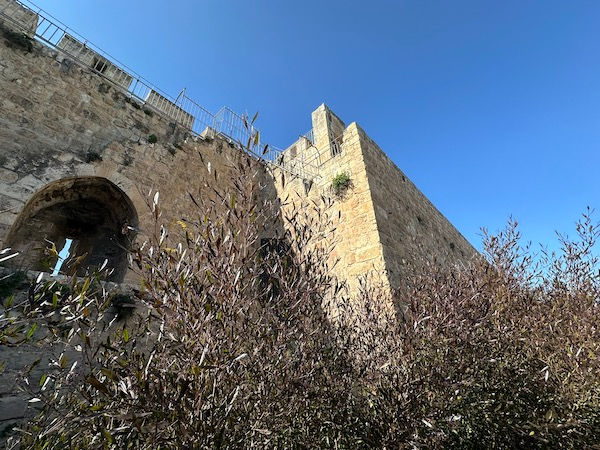

The Walls of the Old City
The Western Wall (or Wailing Wall) is one of the holiest sites in Judaism and an important destination for Christian pilgrims visiting the Holy Land. This ancient wall is all that remains of the retaining wall of the Second Temple, destroyed by the Romans in 70 CE. Over the centuries, it has become a symbol of mourning for the lost Temple and hope for its restoration.
Since the Middle Ages and up to the present day, millions of pilgrims from all over the world come to the Wall to pray, place written notes in its crevices, and touch stones that date back thousands of years. The Wall is built of massive limestone blocks, with its lower sections dating to the time of King Herod.
The Lesser Western Wall
A short walk from the main plaza, hidden in a narrow alley behind the Arab market, lies the Lesser Western Wall. This sacred site is believed to be the closest accessible point to the Holy of Holies of the destroyed Temple. Smaller, quieter, and more intimate than the main section, it is considered an especially suitable place for personal prayer and reflection.
During Muslim rule and the Ottoman Empire, access to the Wall was restricted. Only in the 20th century, especially after the reunification of Jerusalem in 1967, did it become freely accessible to people of all faiths. Today, Jews, Christians, and Muslims alike recognize it as a sacred place.
For Christians, the Western Wall carries special meaning as a remnant of the Temple where Jesus once taught. Many pilgrim routes include it alongside the Via Dolorosa and the Church of the Holy Sepulchre.
Visitor Information
-
Location: Old City of Jerusalem, Jewish Quarter. Entry via the Dung Gate.
-
Access: Open 24/7, free of charge. Security checks at the main entrance.
-
Dress Code: Modest clothing recommended. Men are provided with kippahs at the entrance. Separate sections for men and women.
-
Lesser Western Wall: Located on Ha-Gai Street, north of the main plaza. Accessible during daylight hours. Less formal, with no dress code checks.
The Western Wall and its lesser-known counterpart are not just architectural remains — they are living touchpoints with three millennia of faith, sorrow, hope, and spiritual longing.


